
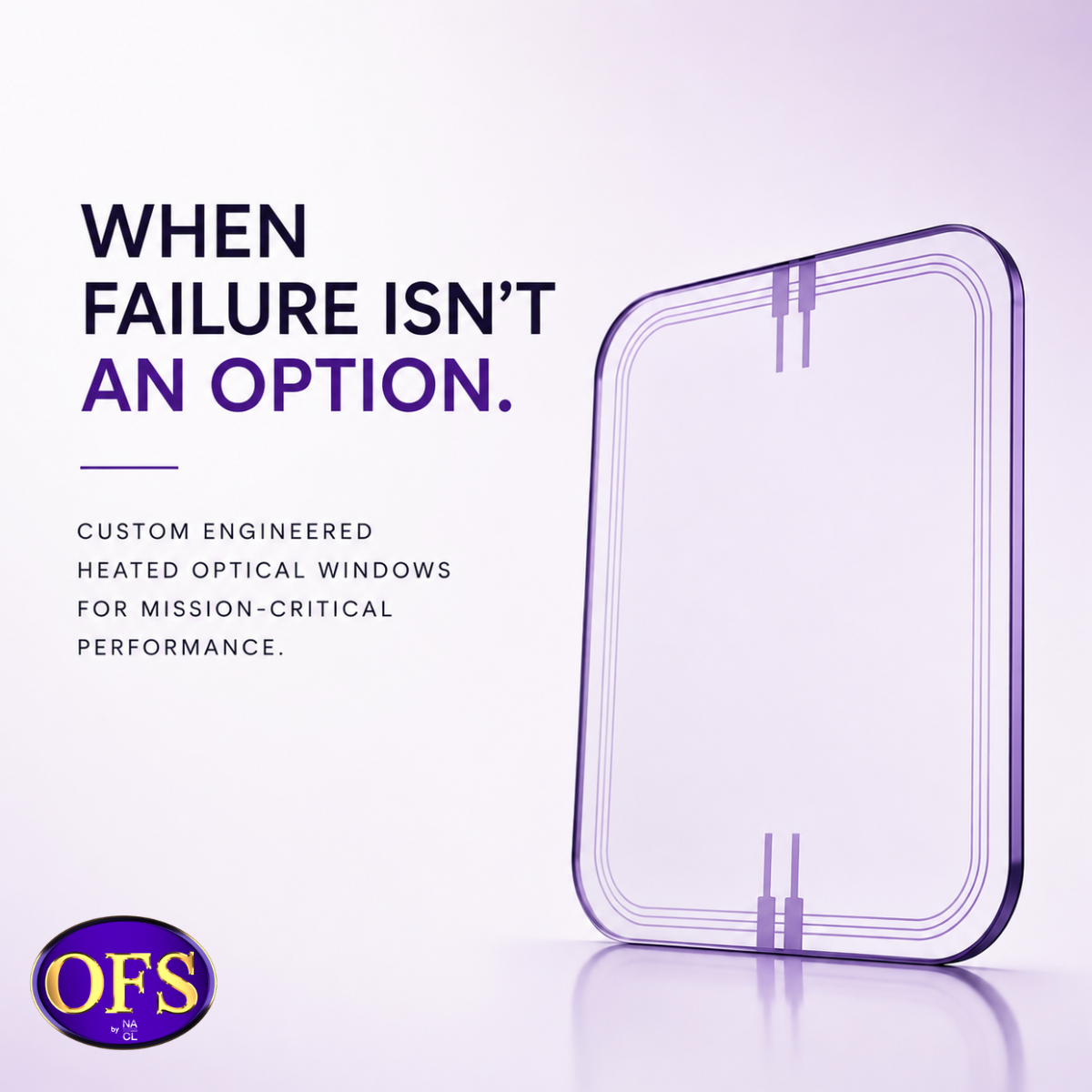
There are some technologies you simply expect to work.
You don’t think about the navigation system guiding an aircraft through difficult conditions. You don’t question whether an imaging system will function in freezing temperatures. And you certainly don’t expect a targeting system to lose clarity because of condensation or ice.
In defense applications, reliability isn’t a convenience. It’s a requirement.
Every component within an optical system must perform with absolute precision, regardless of the environment. When visibility is compromised, mission effectiveness can be compromised as well.
That’s why heated optical windows have become essential technology for advanced defense platforms.
The Challenge of Seeing Clearly in Any Environment
Modern optical systems face an incredible range of environmental conditions.
Rapid temperature changes, humidity, freezing conditions, and harsh operating environments can all create condensation or ice formation on critical optical surfaces. Even slight thermal inconsistencies can degrade image quality, reduce sensor effectiveness, or interfere with targeting accuracy.
The challenge extends beyond simply adding heat.
The heating system must maintain optical clarity while delivering uniform thermal performance, preserving spectral transmission, and surviving demanding operational conditions.
Balancing all of these requirements within a single optical component requires significant engineering expertise.
Combining Optical and Thermal Performance
One of the most effective approaches to heated optical windows incorporates transparent conductive oxide (TCO) coatings integrated with precision bus bar designs.
Unlike traditional heating elements that obstruct the optical path, transparent conductive coatings allow electrical current to pass across the surface while maintaining high optical transmission.
When properly engineered, the result is a window capable of generating controlled, uniform heat while preserving the optical performance required for advanced imaging and targeting systems.
Achieving that balance, however, is far from simple.
Every design decision influences electrical resistance, heat distribution, optical transmission, durability, and manufacturability.
Optimizing one characteristic often impacts another, making system-level engineering essential.
Innovation Through Collaboration
Some engineering challenges don’t have existing solutions.
They require creating something entirely new.
In one advanced defense application, the objective was to develop a heated optical window capable of delivering both exceptional spectral performance and reliable thermal control under demanding operational conditions.
Rather than adapting an existing product, the solution required completely new coating architecture.
Working collaboratively with the customer, the engineering team developed:
- A custom transparent conductive oxide coating
- An integrated precision bus bar heating design
- A system optimized for both optical and thermal performance
- Specialized tooling and manufacturing processes built specifically for the application
The result was not simply a product improvement, it was the creation of a first-of-its-kind solution.
Innovation often happens when engineering teams are willing to rethink established approaches instead of accepting existing limitations.
Precision Manufacturing Matters
Advanced optical coatings demand equally advanced manufacturing capabilities.
Maintaining coating uniformity, electrical consistency, and optical performance requires precise process control throughout production.
Small variations in thickness or resistance can influence thermal distribution, while dimensional inconsistencies can impact integration into larger systems.
By combining precision photolithography, conductive coating expertise, custom tooling, and rigorous quality processes, manufacturers can produce heated optical windows that deliver repeatable performance for highly specialized applications.
In mission-critical environments, consistency matters just as much as innovation.
The Technologies You Never See
Many of the most important technologies operate quietly in the background.
Users don’t think about the optical coating preventing reflections. They don’t notice the conductive layer preventing ice formation. They simply trust that the system will work when called upon.
That invisible reliability is the hallmark of exceptional engineering.
At Optical Filter Source, every project begins with understanding the application—not forcing an application into an existing solution.
Whether developing transparent conductive coatings, precision bus bar designs, heated optical windows, or custom photolithographic patterns, the goal remains the same: engineer solutions that perform reliably under the conditions where failure is not an option.
Because sometimes the greatest innovations are the ones no one ever notices.
They’re simply the reason everything else works.